What exactly is muscle soreness?
After strenuous exercise, when resuming physical activity, or as a result of an infection (e.g. the flu), muscle soreness can develop up to 2 days after exercise.3 Here are the causes and most common symptoms.
Why do I get muscle soreness?
It's your muscles' way of telling you that they're not used to doing so much! It's important to remember that your muscles are made up of a large number of fibers. When you overwork them, certain fibers can be damaged, resulting in mini cracks.4 These are what cause inflammation 12 to 48 hours later2, while they repair themselves spontaneously over the following 4 to 5 days.4 It can be painful. Sometimes, these mini-cracks can persist even though the pain has disappeared.5 That's why you need to be careful when resuming sport. As the muscle is somewhat weakened, you increase the risk of injury.5
Symptoms of muscle soreness
Muscle soreness occurs 12 to 48 hours after exercise.2 The pain is dull at rest, and increases upon movement (sometimes with the slightest movement). Muscle soreness can also be accompanied by a reduction in muscle strength and joint range. You feel stiff.5
Unlike most sports injuries and cramps, pain is not felt at the moment of activity.6

Managing muscle soreness... Let us guide you!
Even if they're not serious, muscle soreness can be particularly painful. Fortunately, there are several ways to relieve them, and the best way to combat them is to avoid them in the first place. Here's how!7
You can avoid muscle soreness
No, not by quitting sport. Preventing muscle soreness is the most effective way of limiting its occurrence.
- Warm up before exercise, It wakes up your muscles by increasing blood flow to them.7
- Don't stop an intense effort abruptly; it's better to allow sufficient time for active recovery, such as walking for a few minutes after a run.8
- Stay well hydrated during exercise (and even afterwards) to compensate for the loss of water through perspiration.9
Gradually increasing physical effort will help strengthen muscle fibres. In short, you need to train regularly, and step by step.10
Doliprane 1000 is not the only solution to muscle pain11
- Relieving them naturally
Certain things can help relieve pain: a good massage or the application of a heat source, such as a hot bath, can help relax muscles.12
The effect of cold on sore muscles can also relieve pain and reduce swelling, for example by applying an ice pack to affected areas.13
- Using paracetamol
The first recommended treatment for muscle soreness is non-pharmacological therapy.15 If the pain persists, you can take an analgesic containing paracetamol16, such as Doliprane 1000.11
Before taking paracetamol, please read the package insert carefully. Ask your pharmacist for advice. If pain persists for more than 5 days, consult your doctor.13

*INCORRECT USE COULD BE HARMFUL
- Mayoclinic. Exercise: 7 benefits of regular physical activity. Available at: https://www.mayoclinic.org/healthy-lifestyle/fitness/in-depth/exercise/art-20048389, Last accessed: 03/10/2024.
- Houston Methodist. Muscle Soreness After a Workout: Can It Be Prevented? Available at: https://www.houstonmethodist.org/blog/articles/2021/sep/muscle-soreness-after-a-workout-can-it-be-prevented, Last Accessed: 03/10/2024.
- ClevlandClinic. Muscle pain. Available at: https://my.clevelandclinic.org/health/symptoms/17669-muscle-pain, Last Accessed: 03/10/2024.
- Armstrong RB, Warren GL, Warren JA. Mechanisms of exercise-induced muscle fibre injury. Sports medicine. 1991 Sep;12:184-207.
- Hospital for Special Surgery. Muscle Strain: Causes, Symptoms, Treatment. Available at: https://www.hss.edu/conditions_muscle-strain.asp, last Accessed: 03/10/2024.
- Permanente Medical Group. Pain After Exercise? It May be Delayed Onset Muscle Soreness. Available at: https://mydoctor.kaiserpermanente.org/mas/news/pain-after-exercise-it-may-be-delayed-onset-muscle-soreness-2477566, Last Accessed: 03/10/2024.
- Family doctor. Sore Muscles from Exercise. Available at: https://familydoctor.org/sore-muscles, Last Accessed: 03/10/2024.
- Dupuy O, Douzi W, Theurot D, Bosquet L, Dugué B. An evidence-based approach for choosing post-exercise recovery techniques to reduce markers of muscle damage, soreness, fatigue, and inflammation: a systematic review with meta-analysis. Frontiers in physiology. 2018 Apr 26;9:403.
- Better Health. Exercise - the low-down on hydration. Available at: https://www.betterhealth.vic.gov.au/health/healthyliving/Exercise-the-low-down-on-water-and-drinks, Last Accessed: 03/10/2024.
- The American College of Sports Medicine® (ACSM). Delayed Onset Muscle Soreness (DOMS). Available at: CPI brochure template.qxd (acsm.org), Last Accessed: 03/10/2024.
- Egyptian Drug Authority (EDA) Doliprane approved leaflet. Date of approval: 04/01/2021.
- Clevlandclinic. Benefits of Hot Tubs. Available at: https://health.clevelandclinic.org/benefits-of-hot-tubs, last Accessed: 03/10/2024.
- NHS inform. Pain and injuries after exercise. Available at: https://www.nhsinform.scot/illnesses-and-conditions/muscle-bone-and-joints/pain-and-injuries-after-exercise/#:~:text=Sore%20muscles%20after%20exercise,a%20bit%20harder%20than%20usual, Last accessed: 03/10/2024.
- Mayoclinic. Muscle pain. Available at: https://www.mayoclinic.org/symptoms/muscle-pain/basics/when-to-see-doctor/sym-20050866?p=1, Last Accessed: 03/10/2024.
- American College of physicians. Nonpharmacologic and Pharmacologic Management of Acute Pain From Non–Low Back, Musculoskeletal Injuries in Adults: A Clinical Guideline From the American College of Physicians and American Academy of Family Physicians. Available at: https://www.acpjournals.org.... Last Accessed: 03/10/2024.
- Practice Guidelines. Low Back Pain: American College of Physicians Practice Guideline on Noninvasive Treatments. Available at: <FFFC>Low Back Pain: ACP Practice Guideline on Noninvasive Treatments (aafp.org), Last accessed: 03/10/2024.

Our products
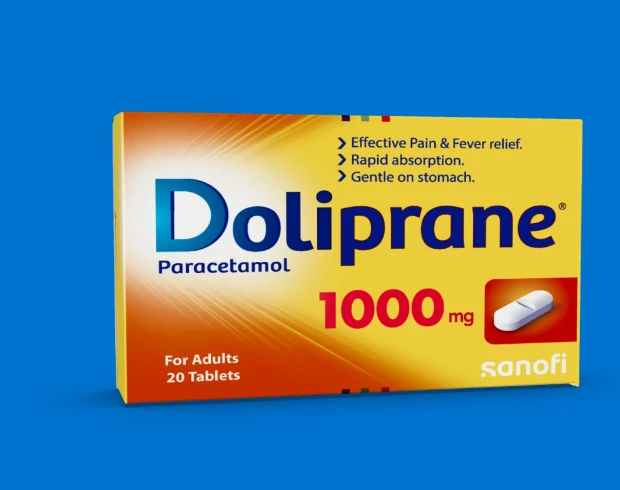
Doliprane Tabs 1000 mg
Oblong, 1000 mg Paracetamol tablet.1
Doliprane is indicated for the symptomatic treatment of clinical conditions requiring an analgesic and/or an antipyretic such as:1
- Symptomatology associated with flu or hyperthermia related to infection
- Fever reaction to vaccination
- Headaches and migraines
- Toothache, earache, period, traumatic, muscle, joints or osteoarthritic pain
- Analgesic before and after surgical procedures
Approved by Egyptian Drug Authority: HF0253OA3411/0420255 Invalidation date: 27/04/2027. Kindly report any violated online promotional, educational and awareness material not having this message to The General administration for Regulation of Marketing & Advertising Materials at: www.edaegypt.gov.eg
HF0253OA3411/042025
27/04/2027