Understanding your pain is key to effective treatment.
Pain may be anything from a dull ache to a sharp stab and can range from mild to extreme. You may feel pain in one part of your body, or it may be widespread.4
Ever wondered, 'Why does it hurt?'4
Well, our bodies are incredibly complex systems!4
We have built-in pain receptors that act like alarms.4
When you feel pain, it's your body's way of saying, 'Something's wrong.'4
This signal can cause you to react quickly, like pulling your hand away from a hot stove.4
There are two possible scenarios.

*INCORRECT USE COULD BE HARMFUL
'It's okay, it went away on its own.'
If the pain disappears quickly, so it is a normal response to an injury or medical condition and it starts suddenly.4
'It still hurts.'
But if the pain persists or intensifies, something is wrong. If pain persists, you should consult your doctor to discover its origin and manage it.4
Doliprane 1000 isn't the only solution for pain and fever.

*INCORRECT USE COULD BE HARMFUL
While paracetamol can provide relief, it doesn't cure the underlying cause.2
What I should do before taking paracetamol?
My immediate reaction is to read the instructions to avoid any contraindications, risk of overdose, and to ask my pharmacist for advice if I have any doubts.
To avoid an overdose, I check if paracetamol is present in other medications I'm already taking.2


Risks of taking too much paracetamol2
If you take too much paracetamol, your liver can't handle it.
This can lead to a buildup of harmful substances, which is dangerous. This is called 'liver toxicity'.
Why it's important to use paracetamol correctly2
That's why it's important to always take the right amount of paracetamol and to ask your doctor if you have any questions. It's also important to tell your doctor about any other medications you're taking..
Can I give paracetamol to a child?
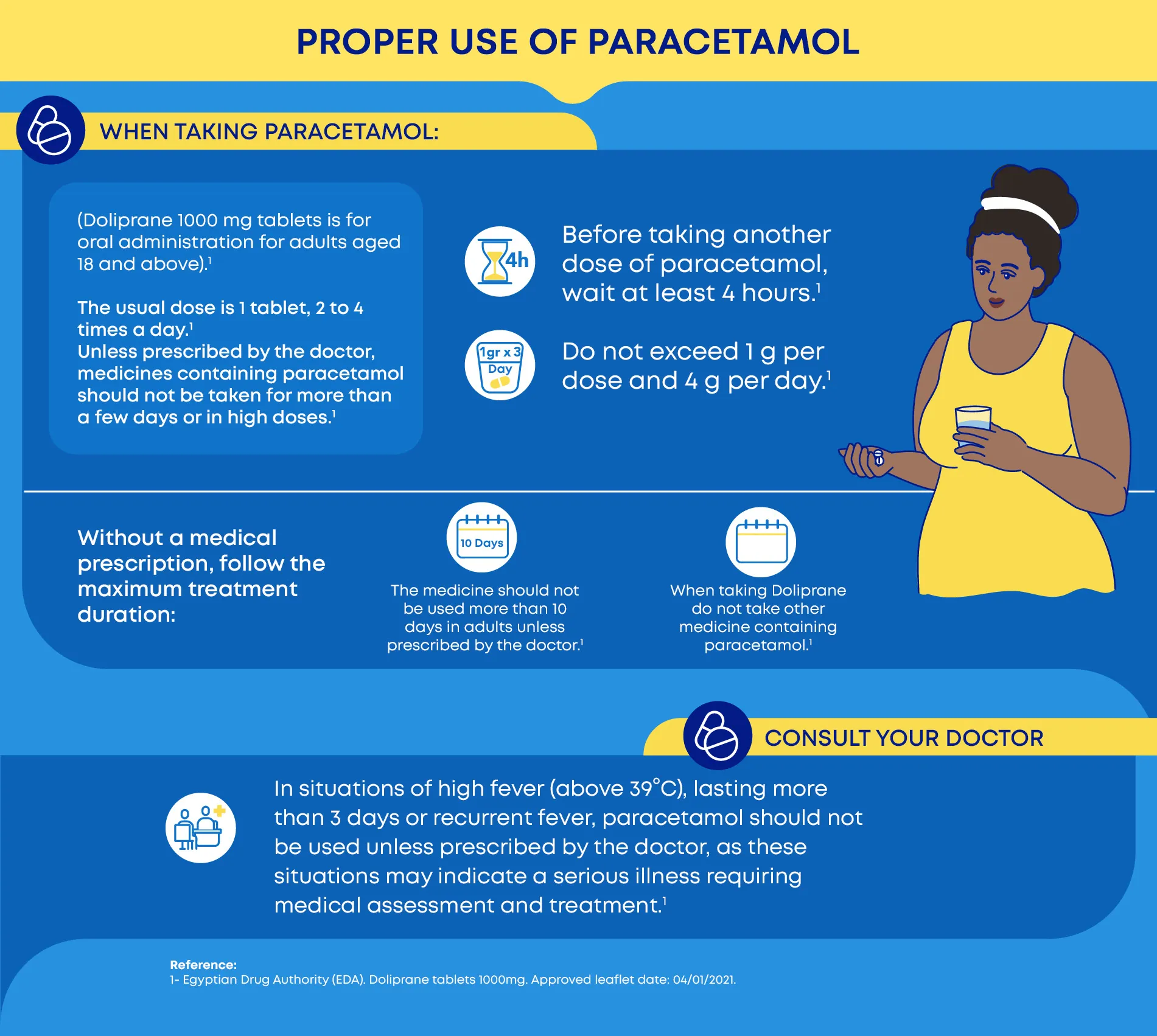
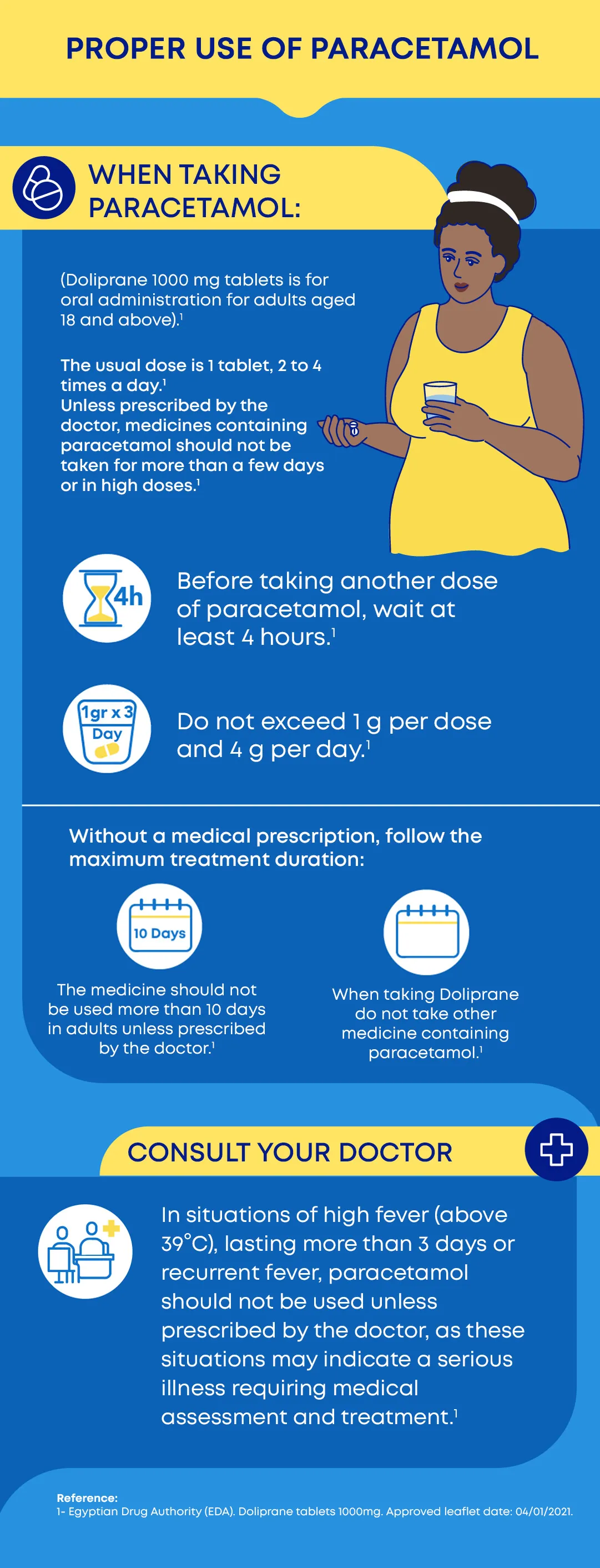
No, Doliprane is for oral administration in adults aged 18 and above.2
The usual dosage is:2
- The usual dosage for Doliprane is 1 tablet, 2 to 4 times a day.
- Administration can be repeated at 4 - 8 hour intervals, depending on the clinical situation.
- Maximum daily dose is 4 tablets (i.e., 4 g paracetamol/day).
What should I know if I am pregnant or breastfeeding?
Paracetamol should only be used during pregnancy after a careful risk-benefit assessment.
If clinically needed, paracetamol can be used during pregnancy however it should be used at the lowest effective dose for the shortest possible time and at the lowest possible frequency.2
If you're breastfeeding, it's best to follow your doctor's advice on the correct dosage of paracetamol.2
What should I know if I am pregnant or breastfeeding?
*INCORRECT USE COULD BE HARMFUL
When should I avoid taking paracetamol?
Doliprane is contraindicated in the following situations:2
- Hypersensitivity to the active substance or to any of the excipients.
- Serious hepatic disease.
If you have any of the following conditions, talk to your doctor before taking paracetamol:2
- In therapeutic doses paracetamol is relatively nontoxic. However, allergic reactions may occur, including anaphylaxis.
- In the following situations the medicinal product should only be used with particular caution (i.e., with adjustment of doses or intervals of administration) and under medical supervision:
- Hepatic insufficiency (e.g., due to chronic alcohol abuse, hepatitis)
- Renal insufficiency.
- Gilbert's disease
- Precaution in the administration of paracetamol is recommended for patients with severe renal impairment, severe liver disease or severe hemolytic anemia.
- Paracetamol must be used with caution in situation dehydration or malnutrition.
- Prolonged use of analgesics or inappropriate use of high doses can cause headaches which should not be treated with increased doses of the medicine.
- The medicine should not be used for more than 10 days in adults unless prescribed by the doctor.
- In situations of high fever (above 39°C), lasting more than 3 days or recurrent fever, paracetamol should not be used unless prescribed by the doctor, as these situations may indicate a serious illness requiring medical assessment and treatment.
- During treatment with Doliprane, do not take other medicines containing paracetamol.
To wrap up
Paracetamol is generally safe and effective when used correctly.2
This means taking the right dose for the right person and at the right time.
"I make sure to follow the instructions and take the correct amount of medication each time."
Overdosing can seriously harm my liver. If my symptoms don't go away, I'll see a doctor.
- Egyptian Drug Authority (EDA). Doliprane approved artwork. Approval date: 11/08/2022.
- Egyptian Drug Authority (EDA). Doliprane tablets 1000mg. Approved leaflet date: 04/01/2021.
- Health Direct, Paracetamol – uses, side effects and how to take it. Available at: https://www.healthdirect.gov.au/paracetamol#not. [Last accessed: 10/10/2024].
- Better Health Channel. Pain and pain management. Available at: https://www.betterhealth.vic.gov.au/health/conditionsandtreatments/pain-and-pain-management-adults. [Last accessed: 10/10/2024].
- National Health Services (NHS). Headaches. Available at: https://www.nhs.uk/conditions/headaches. [Last accessed: 10/10/2024].
- Cleveland Clinic. Liver: What It Does, Disorders & Symptoms. Available at: https://my.clevelandclinic.org/health/articles/21481-liver. [Last accessed: 10/10/2024].

Our products
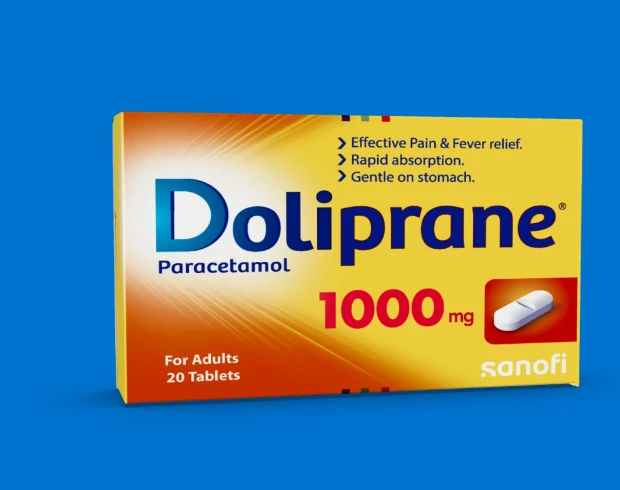
Doliprane Tabs 1000 mg
1000 mg Paracetamol tablet.1
Doliprane is indicated for the symptomatic treatment of clinical conditions requiring an analgesic and/or an antipyretic such as:1
- Symptoms associated with flu or hyperthermia related to infection
- Fever reaction to vaccination
- Headaches and migraines
- Toothache, earache, period, traumatic, muscle, joints or osteoarthritic pain
- Analgesic before and after surgical procedures
Approved by Egyptian Drug Authority: HF0253OA3253/022025 Invalidation date: 20/02/2027. Kindly report any violated online promotional, educational and awareness material not having this message to The General administration for Regulation of Marketing & Advertising Materials at: www.edaegypt.gov.eg

HF0253OA3253/022025
20/02/2027