Menstruation: How and why?
It's important to remember their natural function, so we can feel comfortable talking about them when they're around. With half of humanity having a period in their lifetime, there's no better reason to stop making it a taboo, is there?
A quick refresher on menstruation?
Menstruation is the result of the ovum not being fertilized. This means two things1:
- Firstly, the ovum has been released, and the uterus is now ready for the arrival of a potential embryo.
- Secondly, the superficial layer of the uterine mucous membrane is shedding, accompanied by bleeding - that's menstruation.
Basically, our uterus resets and starts from scratch.

"MY HEALTH TIPS"
Egypt is home to nearly 20 million girls under the age of 19, including 30% who have begun menstruating. Due to certain misconceptions and lack of access to accurate information, many girls find it difficult to ask questions about menstruation, how to care for themselves, have access to needed items such as sanitary pads, medical services, advice and guidance.2
Therefore, education, access to information and family support around menstruation play a crucial role in empowering girls at this important stage in their lives, particularly in relation to physical and mental health and body safety.2
Painful periods: a special case, two scenarios
For some women, menstruation can be much more painful than normal. Intense cramps or spasms can even be felt from the abdomen downwards. It's important to distinguish between 2 cases5:
- Pain occurring during the first menstrual period in adolescence3,
- Pain occurring in adults who previously felt little or no pain3.
The steps to take differ in each case.
Painful periods as a teenager? Don't even worry about it!
Even if your period is painful, and the pain should be properly treated, there's nothing serious about it, and most of the time there are no complications.4 Many of us go through it (50-90%)5, and an increasing number of us dare to talk about it. This type of painful menstruation (also known as primary dysmenorrhea) begins with puberty, in the months following our first period.3 The intensity of the pain can sometimes force you to stay at home. No outings with friends, no parties and no school. In short, you can become bedridden.6
The explanation? The culprit is a secretion of hormones (thanks again to puberty) which causes the uterus to contract more frequently and more strongly than normal, causing more pain.3 The good news? Pain generally diminishes and disappears with age. If this isn't the case, it's time to talk to your gynecologist.3

How can I relieve this pain?
Since it's not a disease, painful periods during teenage years can't be cured. However, the pain itself can be treated.7
There are some things you can do to help ease period pain8
- Getting as much rest as possible before and during menstruation8;
- Relaxing the lower abdomen and lower back with the help of warmth: there's nothing like the vintage pleasure of a hot-water bottle or a hot shower;9
- Practicing gentle physical activity, such as stretching, yoga, walking or swimming, to stimulate blood circulation and reduce cramps.9
If these methods aren't enough, an NSAID or paracetamol-based painkiller can provide relief.9
Doliprane 1000 is available in the form of tablets.10


Warning!
*INCORRECT USE COULD BE HARMFUL

*INCORRECT USE COULD BE HARMFUL
Painful periods during adulthood
Whether you're young or old, painful periods have a major impact on your personal lifestyle, as well as your working life.7
In Egypt, a study reported that 94.6% of women working in two textile factories in Beni-Suef experienced dysmenorrhea in the past 12 months, highlighting its prevalence as one of the most common gynecological disorders worldwide.11
Experiencing abdominal pain during your period, although you never had any before, deserves special attention.
Once you've checked that it's not related to a digestive problem, if it's accompanied by other symptoms such as bleeding between periods, abnormally heavy flow , it could be secondary dysmenorrhea.12 Report these symptoms to your doctor/gynaecologist to identify the cause. Further tests may be necessary, and appropriate treatment may be prescribed depending on the diagnosis. An analgesic containing paracetamol, such as Doliprane 1000, may be prescribed to relieve the pain.10
To wrap up
Most of us are familiar with that uncomfortable abdominal pain around the time of menstruation. If non-medicinal solutions don't help9, your pharmacist can provide you with NSAID- or paracetamol-based analgesics such as Doliprane 1000.10 However, painful periods can have many causes, which is why it's important to talk to your doctor/gynaecologist or emergency department in the event of unusually severe pain.9
- Clevlandclinic. Menstrual cycle. Available at: https://my.clevelandclinic.org/health/articles/10132-menstrual-cycle, Last Accessed: 07/10/2024.
- UNICEF. The Menstrual Cycle. Available at: The Menstrual Cycle | UNICEF Egypt, Last Accessed: 07/10/2024.
- University of Rochester Medical Center. Menstrual Cramps (Dysmenorrhea) in Teens. Available at: https://www.urmc.rochester.edu/encyclopedia/content.aspx?ContentTypeID=90&ContentID=p01599#:~:text=Key%20points%20about%20menstrual%20cramps%20in%20teens&text=It's%20usually%20lifelong.-,But%20it%20may%20get%20better%20over%20time.,as%20a%20growth%20or%20infection, Last Accessed: 07/10/2024.
- Clevland clinic. Dysmenorrhea (Menstrual Cramps). Available at: https://my.clevelandclinic.org/health/diseases/4148-dysmenorrhea, Last Accessed: 07/10/2024.
- American Academy of Family Physicians. Dysmenorrhea. Available at: https://www.aafp.org/pubs/afp/issues/2021/0800/p164.html, Last Accessed: 07/10/2024.
- Wellbeing of Women. Teenagers say their periods leave them ‘bed bound’ unable to eat or sleep, and feeling like life isn’t worth living. Available at: https://www.wellbeingofwomen.org.uk/news/teenagers-say-their-periods-leave-them-bed-bound-unable-to-eat-or-sleep-and-feeling-like-life-isnt-worth-living, Last accessed: 07/10/2024.
- Yale medicine. Dysmenorrhea. Available at: https://www.yalemedicine.org/conditions/dysmenorrhea, Last Accessed: 07/10/2024.
- Medline plus. Period Pain. Available at: https://medlineplus.gov/periodpain.html, Last Accessed: 07/10/2024.
- NHS. Period Pain. Available at: https://www.nhs.uk/conditions/period-pain, Last Accessed: 07/10/2024.
- Egyptian Drug Authority (EDA) Doliprane approved leaflet. Date of approval: 04/01/2021.
- Arafa AE, Khamis Y, Hassan HE, Saber NM, Abbas AM. Epidemiology of dysmenorrhea among workers in Upper Egypt; A cross sectional study. Middle East Fertility Society Journal. 2018 Mar 1;23(1):44-7.
- Statpearls. Dysmenorrhea. Available at: https://www.ncbi.nlm.nih.gov/books/NBK560834/?report=printable, Last Accessed: 07/10/2024.

Our products
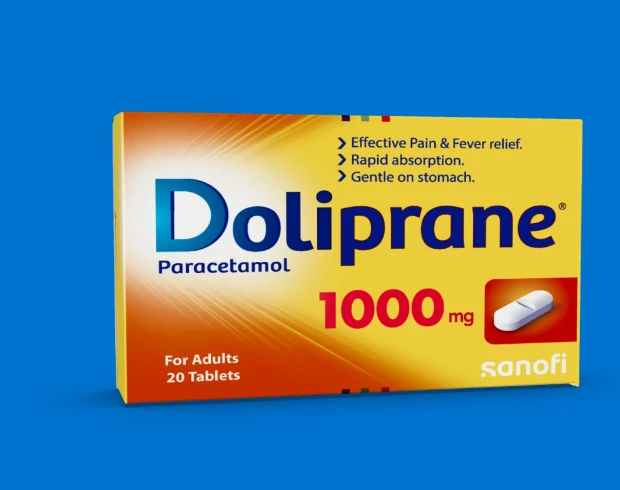
Doliprane Tabs 1000 mg
Oblong, 1000 mg Paracetamol tablet.1
Doliprane is indicated for the symptomatic treatment of clinical conditions requiring an analgesic and/or an antipyretic such as:1
- Symptomatology associated with flu or hyperthermia related to infection
- Fever reaction to vaccination
- Headaches and migraines
- Toothache, earache, period, traumatic, muscle, joints or osteoarthritic pain
- Analgesic before and after surgical procedures
Approved by Egyptian Drug Authority: HF0253OA3411/0420255 Invalidation date: 27/04/2027. Kindly report any violated online promotional, educational and awareness material not having this message to The General administration for Regulation of Marketing & Advertising Materials at: www.edaegypt.gov.eg
HF0253OA3411/042025
27/04/2027