Self-medication is about taking charge of your health and knowing how to do it right.


*INCORRECT USE COULD BE HARMFUL
Count on your pharmacist for expert advice.
Their advice is essential for guidance and to avoid any risk of misuse or medication errors.
Appropriate self-medication. Real benefits.5
Efficacy: i.e. the product does what it is claimed to do.
Self-reliance in preventing or relieving minor symptoms or conditions.
Economy, particularly since medical consultations will be reduced or avoided.
At the community level, good self-medication can also provide benefits such as saving scarce medical resources from being wasted on minor conditions, lowering the costs of community-funded health care programs (including prescription reimbursement systems), and reducing absenteeism from work due to minor symptoms.
Which medications are allowed for self-medication?
Medicinal products for self-medication may for the present purpose be defined as those which do not require a medical prescription, and which are produced, distributed and sold primarily with the intention that they will be used by consumers on their own initiative and responsibility, when they consider such a use appropriate.
What are the risks to avoid?1
The potential risks of self-medication include using inappropriate drugs or inaccurate dosages, which may result in adverse reactions.
It may temporarily mask symptoms and delay patients from seeking medical advice, which could result in serious complications.
Consulting your pharmacist is essential.
Risks associated with misuse2

*INCORRECT USE COULD BE HARMFUL
Irrational use of analgesics may lead to adverse events including a variety of gastrointestinal complications, adverse effects on kidney function, risk of cardiovascular events and hepatic injury.
Self-medication with antibiotics has the serious potential for development of drug-resistant microorganisms and hence future treatment failure.
The Golden Rules of Self-Medication5
In selecting the types of medicinal products that can be used for self-medication, the aim should be to exploit the benefits and to minimize the risks.
Rules for Choosing Your Medication
- Always consult your pharmacist: pharmacists in particular can play a key role in giving advice to consumers on the proper and safe use of medicinal products intended for self medication.5
- Report any risk factors:5
- Elderly people, during pregnancy and lactation, and in patients with impaired liver or kidney function.
- Elderly people, during pregnancy and lactation, and in patients with impaired liver or kidney function.
- Inform your pharmacist if you are already taking other medications.5
Rules Before Taking Medication

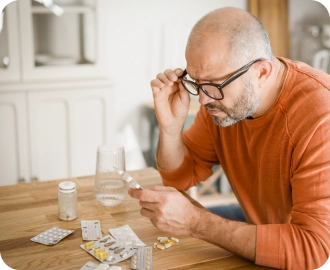
*INCORRECT USE COULD BE HARMFUL
Rules to Follow During Treatment
- Do not self-medicate with multiple medications without first consulting a pharmacist. The risk of drug interactions can cause or worsen side effects.5
- Adhere to the maximum dosage per dose, acceptable risk, even when used for a longer duration, or somewhat differently than recommended in the instructions.5
- Report any adverse events, even those that seem minor, to your doctor or pharmacist.5
To wrap up
Self-medication today: how can we live without it?
Accessing treatment without a prior medical opinion does not mean without the advice of your pharmacist; they remain the guarantor of its usefulness and your safety.1
When you feel pain, it's your body's way of saying, 'Something's wrong.'6
This signal can cause you to react quickly, like pulling your hand away from a hot stove.3
- El Nimr NA, Wahdan IM, Wahdan AM, Kotb RE. Self-medication with drugs and complementary and alternative medicines in Alexandria, Egypt: prevalence, patterns and determinants. EMHJ-Eastern Mediterranean Health Journal. 2015;21(4):256-65.
- National Health Services (NHS). Headaches. Available at: https://www.nhs.uk/conditions/headaches. [Last accessed: 10/10/2024].
- Better Health Channel. Pain and pain management. Available at: https://www.betterhealth.vic.gov.au/health/conditionsandtreatments/pain-and-pain-management-adults. [Last accessed: 10/10/2024].
- National Health Services (NHS). Self-Medication Procedure. Available at: https://www.tewv.nhs.uk/wp-content/uploads/2021/11/Self-medication-procedure.pdf. [Last accessed: 10/10/2024].
- Ogasawara H, Japan DC, Indonesia M. WHO guidelines for the regulatory assessment of medicinal products for use in self-medication. WHO Drug Information. 2000;14(1).
- Cleveland Clinic. Pain Management: What It Is, Types, Benefits & Risks. Available at: https://my.clevelandclinic.org/health/treatments/21514-pain-management. [Last accessed: 10/10/2024].

Our products
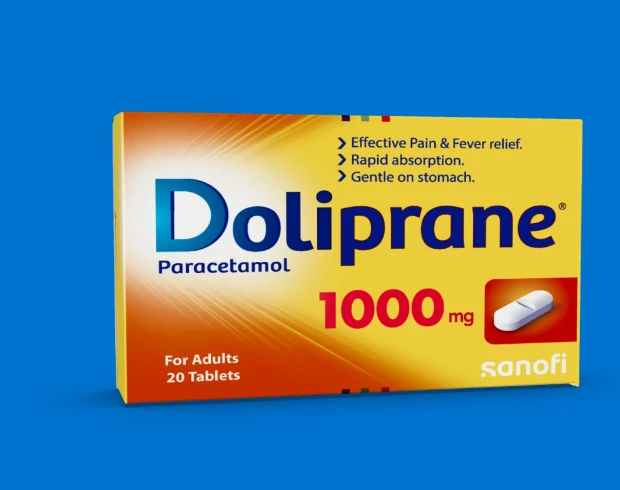
Doliprane Tabs 1000 mg
Oblong, 1000 mg Paracetamol tablet.1
Doliprane is indicated for the symptomatic treatment of clinical conditions requiring an analgesic and/or an antipyretic such as:1
- Symptomatology associated with flu or hyperthermia related to infection
- Fever reaction to vaccination
- Headaches and migraines
- Toothache, earache, period, traumatic, muscle, joints or osteoarthritic pain
- Analgesic before and after surgical procedures
Approved by Egyptian Drug Authority: HF0253OA3253/022025 Invalidation date: 20/02/2027. Kindly report any violated online promotional, educational and awareness material not having this message to The General administration for Regulation of Marketing & Advertising Materials at: www.edaegypt.gov.eg

HF0253OA3253/022025
20/02/2027